

一吻定情2


分类: 绝代双骄
三少爷的剑
Why Asia Won't Reject Russia's Hydrocarbons or China's Rare Earths Despite US Pressure_我的网站

A | "Given that energy is the lifeline of modern economies, modern economic growth patterns, there are not that many alternatives available and there are only a few countries that are players in the global energy market. Russia certainly cannot be counted out and Russia cannot be marginalized in the global energy landscape," says Harsh V. Pant, professor of international relations at the King's College London India Institute and director of the strategic studies program at the Observer Research Foundation.,International Energy Agency (IEA) Executive Director Fatih Birol and US Energy Secretary Jennifer Granholm on 12 July urged Indo-Pacific countries at the Sydney Energy Forum to diversify their supply chains for energy and critical minerals to reduce "dependency" on Russia over its special operation in Ukraine, as well as on China.,"At a time when the energy prices are going up and affecting some of the poorest and most vulnerable countries around the world very significantly, I think Asian countries will continue to cooperate with Russia in order to support their economies and their domestic requirements," says Pant.,He explains that dealing with Russia has become an economic imperative at a time of energy crunch given that Moscow is offering discounted oil to a number of countries. Furthermore, maintaining economic relations with Russia is a question of survival and the people's well-being for some Asian nations and countries of the Global South, according to the professor. Under these circumstances it's highly unlikely that they will succumb to the pressure from Washington and sever ties with Russia, he says.,"For political leaders across the world, at a time when economies are just beginning to grow after the long COVID pandemic, they can [not] afford a lack of energy and higher energy prices," Pant stresses.,Russia, Venezuela to Expand Oil Sector Cooperation, Working on Pact to Circumvent Western Sanctions4 July, 11:15 GMT,Anti-Russia Sanctions: India and EU Approaches,To illustrate his point, the professor cites India's approach to Russia's affairs and the Ukraine crisis. New Delhi continues to import energy from Russia despite the US and Europe urging India to join sweeping anti-Russia sanctions.,"What we have seen in the last two months is a gradual, significant increase in what India is buying from Russia when it comes to oil," the professor says. "This is particularly relevant again because Russia has offered India discounted oil and India's economic requirements demand that India continues buying this oil. The challenges facing India's population mean that the Indian leadership has an incentive in continuing to engage with Russia on this question.",At the same time, the European Union's decision to slap sanctions on Russia and slash energy supplies from the country have backfired on Europe's economy, sending fuel prices up and accelerating inflation.,"We have seen how Europe is struggling to reduce its dependence and the kind of costs that it is imposing on Europeans," says Pant. "Most Asian countries would be reluctant to go down that route.",Brussels: Anti-Russia Sanctions Raise Questions About Sustainability of EU's Financial Model 10 June, 08:44 GMT,The disruptions in the supply of crude after the imposition of ban on imports from Russia have given a dramatic boost to energy prices and inflation, echoes Suranjali Tandon, assistant professor at the Delhi-based National Institute of Public Finance and Policy.,"The current inflationary trends are the most serious challenge for policy makers," she says. "Central banks around the world have begun the process of unwinding loose monetary policy… The current inflation rates have led to internal economic strains and as seen in Sri Lanka, a political upheaval. The cooperation between Russia and Asian countries may be economically prudent.",Moreover, major Asian economies – India and China – are ready to absorb crude supplies from Russia rejected by the West, according to her.,At the same time, Washington's plan to force Asian states to join anti-Russia sanctions is fraught with severe risks for the global economy, Tandon warns.,"The ban, if carried out by other Asian economies, will further cut off supplies of refined petroleum and related products," she says. "This could lead to an unmanageable inflationary spiral while depressing global growth.",Lithium, Gold & Rare Earths: How China May Open the Door to New Business Opportunities for Afghans19 August 2021, 08:38 GMT,Are There Alternatives to Russia & China?,According to Tandon, India sets an important precedent for other Asian states by withstanding the US pressure when it comes to energy sanctions against Russia. By doing this, India is defending its internal interests in the first place, the professor underscores.,She hails the idea that single technology or fuel dependence should be avoided. This principle could be applied to Russia, China, or Western countries in a similar way. However, when the West is calling upon Asian nations to shift to wind, solar, and even nuclear power and abandon fossil fuels, it's clear that this shift cannot be done immediately, the professor emphasizes.,Even after the "green" transition, Asian states and the Global South are likely to maintain ties with Russia and China, who have been developing cutting-edge nuclear technologies and mining rare earths needed for producing electric batteries and electronic components.,"Russia's energy supplies will remain globally important," Tandon forecasts. "More importantly, even when this transition does take place the natural resources including minerals used as inputs in renewables will be concentrated in countries like China. China produces 63% of the world’s rare earth elements, including 45% of molybdenum as per IEA, so it's unclear what countries must do to expand alternatives while being under pressure to transition quickly."。
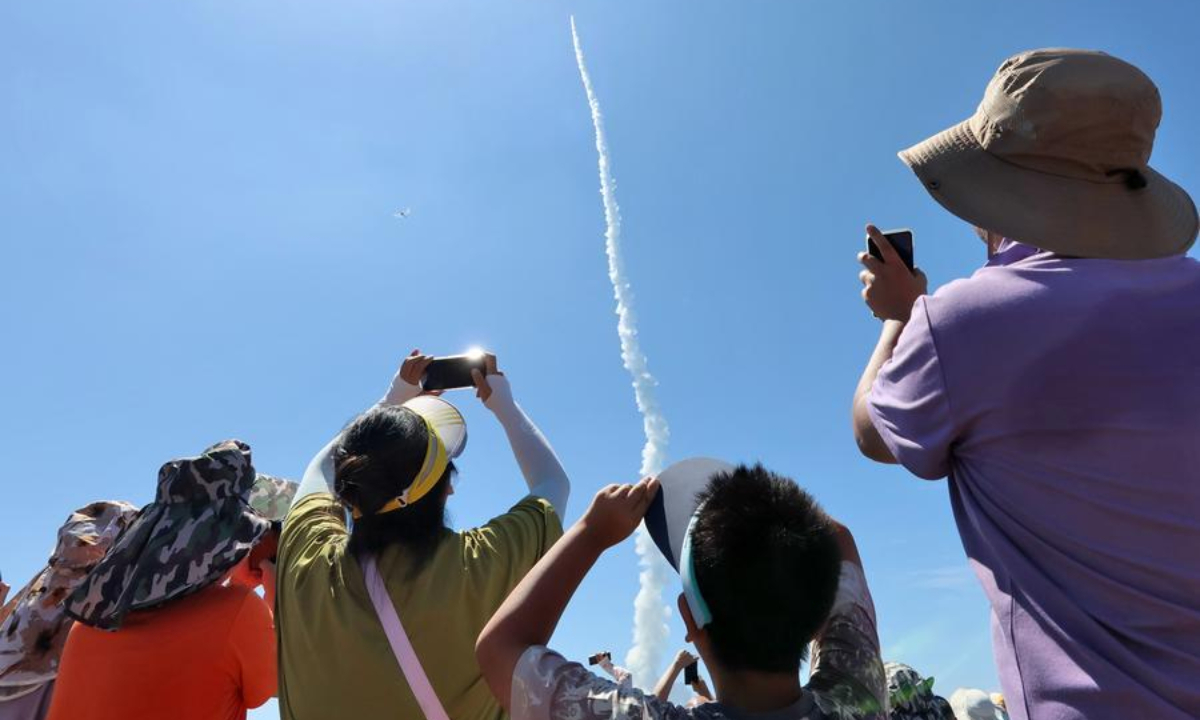
A burst of flame lit the morning sky over waters off Haiyang in east China's Shandong Province on Wednesday as a Smart Dragon-3 (SD-3) carrier rocket lifted off, drawing cheers from viewing sites along the coast.
Among the spectators were international students studying aerospace subjects in China. Aithana Perez, a Venezuelan aeronautical engineer studying space project management at Hangzhou Innovation Institute of Beihang University, said she and her classmates were excited because their studies involved spacecraft launch, design and operation.
For Marwane Oufrid, a 23-year-old Moroccan student in the same institute specializing in microsatellite technology, it was the first time he had watched a rocket launch in person.
The rocket blasted off at 10:38 a.m. (Beijing Time), delivering the Oriental Smart Eye hyperspectral satellites 01 and 02 into planned orbit.
In their respective cooperation projects with Indonesia and Uzbekistan, Satellite 01 is also known as Lampung-1 and Satellite 02 as Samarkand-2028.
Once in orbit, the satellites turned their attention back toward Earth. Lampung-1 is expected to monitor crop growth and disaster risks in Indonesia, while Samarkand-2028 is designed to support cotton cultivation and other land-monitoring applications in Uzbekistan.
Ordinary optical cameras mainly record the shape and color of objects. Hyperspectral imagers record a detailed spectrum for each image pixel, creating "spectral fingerprints" that can help determine the condition and composition of vegetation, water, soil and minerals.
These spectral "eyes" are paired with onboard AI computing modules capable of delivering up to 400 trillion operations per second. Instead of sending every raw image to the ground, the satellites can identify features, detect anomalies and extract useful information in orbit, potentially shortening delivery time from days to minutes.
Song Bingchen, co-founder of the Star.ai Spatio-temporal Intelligence Technology Co., Ltd., whose subsidiary STAR.VISION developed the satellites, compared the system to moving an AI inference platform from the ground into space.
"It changes the traditional model from transmitting images to transmitting results," Song said.
"Our satellite constellations are open to the world," Song noted, adding that the company welcomes international partners to jointly invest in, build and use the satellite networks.
In Indonesia, Lampung-1's planned applications are centered in Lampung Province on the island of Sumatra. Agriculture, forestry and fisheries accounted for 28.38 percent of the provincial economy in the third quarter of 2025. The satellite will also support marine resource management, environmental monitoring and disaster response.
Rahmat Mirzani Djausal, governor of Indonesia's Lampung Province, described the successful launch as a "historic moment" for the province.
"Cooperation with China on this satellite project is of historic and strategic significance," he said. "It marks the beginning of Lampung's transformation into a technologically advanced province."
The governor commended China's openness in sharing space technology and its commitment to long-term cooperation.
"China understands that any problems we face on one side of the world will ultimately impact the other side. Therefore, it is essential to empower regions that are left behind to make the world ultimately a better place," he said.
This cooperation also extends to people. Lampung is preparing to send over 100 young professionals to China for training in remote sensing and satellite communications, with the goal of building local capacity in satellite operation, data processing and spatial analysis.
In Uzbekistan, the applications center on cotton, grain and vegetation monitoring. Samarkand-2028 is designed to follow cotton cultivation from sowing to harvesting, while Uzbekcosmos has said hyperspectral data will also be used to produce national cotton and wheat maps.
Mukhiddin Ibragimov, deputy director of the Uzbekcosmos Agency, described the project as one of the largest international space projects in Uzbekistan's history and a milestone in its national space program.
He called the launch "a great occasion," saying it was the first time Uzbekistan had participated in an international space mission of such scale.
Ibragimov said Uzbekistan sent a technical team to China early in the project and formed a working group with Chinese specialists to develop an AI model for onboard data analysis. This model focuses on crop classification, including cotton verification, grain identification and vegetation monitoring.
The resulting data will support agriculture, water resource management, environmental protection and emergency monitoring, among other applications, he revealed.
Ibragimov said no single country can handle all space-related tasks alone.
"We believe that partnership brings value. We see that China is doing the same thing," he said, adding that Uzbekistan is exploring further satellite cooperation with China.
The projects offer a commercial example of the approach set out in China's 2021 space white paper, which called for international cooperation based on equality, mutual benefit, peaceful utilization and inclusive development.
Back in Haiyang, Oufrid said projects of this kind could give more countries an opportunity to participate in the space sector. He expressed the hope to see such cooperation happen more often and "maybe someday with Morocco as well."
。
Current article:http://uip.ruwentaqintiaozhupapaigai.shop/list_w11z6il/3khqqd.html
Published on:21:42:45


